The real reasons why pastors are so busy

I have been reading Eugene Peterson’s book, The Contemplative Pastor, and like most of his books (which I thoroughly enjoy and am constantly challenged), this one has been messing with my heart.  I praise God for men like Peterson who are able to call things as they are, which is precisely what the gospel does.  Here is but a sample:


I (and most pastors, I believe) become busy for two reasons; both are ignoble.

I
am busy because I am vain.
  I want to appear important.  Significant.  What better way than to be busy?  The incredible hours, the crowded schedule, and the heavy demands on my time are proof to myself – and to all who will notice – that I am important.  If I go into a doctor’s office and find there’s no one waiting, and I see through a half-open door the doctor reading a book, I wonder if he’s any good.  A good doctor will have people lined up waiting to see him; a good doctor will not have time to read a book.  Although I grumble about waiting my turn in a busy doctor’s office, I am also impressed with his importance.

Such experiences affect me.  I live in a society in which crowded schedules and harassed conditions are evidence of importance, so I develop a crowded schedule and harassed conditions.  When others notice, they acknowledge my significance, and my vanity is fed.

I am busy because I am lazy.  I indolently let others decide what I will do instead of resolutely deciding myself.  I let people who do not understand the work of a pastor to write the agenda for my day’s work because I am too slipshod to write it myself.  The pastor is a shadow figure in these people’s minds, a marginal person vaguely connected with matters of God and good will.  Anything remotely religious or somehow well-intentioned can be properly assigned to the pastor.

Because these assignments to pastoral service are made sincerely, I go along with them.  It takes efforts to refuse, and besides, there’s always the danger that the refusal will be interpreted as a rebuff, a betrayal of religion, and a calloused disregard for people in need.

It was a favorite theme of C. S. Lewis that only lazy people work hard.  By lazily abdicating the essential work of deciding and directing, establishing values and setting goals, other people do it for us; then we find ourselves frantically, at the last minute, trying to satisfy a half dozen different demands on our time, none of which is essential to our vocation, to stave off the disaster of disappointing someone.

But if I vainly crowd my day with conspicuous activity or let others fill my day with imperious demands, I don’t have time to do my proper work, the work to which I have been called.  How can I lead people into the quiet place beside the still waters if I am in perpetual motions?  How can I persuade a person to live by faith and not by works if I have to juggle my schedule constantly to make everything fit into place?

This of course doesn’t just apply to pastors, but I think it has application to all of us who have one vocation or another.  May the deep riches of the gospel so grip our heart that we are released from our busy-ness so that we can get down to the real business of resting in Christ and engaging in the important things of life.
The real reasons why pastors are so busy

I have been reading Eugene Peterson’s book, The Contemplative Pastor, and like most of his books (which I thoroughly enjoy and am constantly challenged), this one has been messing with my heart.  I praise God for men like Peterson who are able to call things as they are, which is precisely what the gospel does.  Here is but a sample:

I (and most pastors, I believe) become busy for two reasons; both are ignoble.
I am busy because I am vain.  I want to appear important.  Significant.  What better way than to be busy?  The incredible hours, the crowded schedule, and the heavy demands on my time are proof to myself – and to all who will notice – that I am important.  If I go into a doctor’s office and find there’s no one waiting, and I see through a half-open door the doctor reading a book, I wonder if he’s any good.  A good doctor will have people lined up waiting to see him; a good doctor will not have time to read a book.  Although I grumble about waiting my turn in a busy doctor’s office, I am also impressed with his importance.
Such experiences affect me.  I live in a society in which crowded schedules and harassed conditions are evidence of importance, so I develop a crowded schedule and harassed conditions.  When others notice, they acknowledge my significance, and my vanity is fed.
I am busy because I am lazy.  I indolently let others decide what I will do instead of resolutely deciding myself.  I let people who do not understand the work of a pastor to write the agenda for my day’s work because I am too slipshod to write it myself.  The pastor is a shadow figure in these people’s minds, a marginal person vaguely connected with matters of God and good will.  Anything remotely religious or somehow well-intentioned can be properly assigned to the pastor.
Because these assignments to pastoral service are made sincerely, I go along with them.  It takes efforts to refuse, and besides, there’s always the danger that the refusal will be interpreted as a rebuff, a betrayal of religion, and a calloused disregard for people in need.
It was a favorite theme of C. S. Lewis that only lazy people work hard.  By lazily abdicating the essential work of deciding and directing, establishing values and setting goals, other people do it for us; then we find ourselves frantically, at the last minute, trying to satisfy a half dozen different demands on our time, none of which is essential to our vocation, to stave off the disaster of disappointing someone.
But if I vainly crowd my day with conspicuous activity or let others fill my day with imperious demands, I don’t have time to do my proper work, the work to which I have been called.  How can I lead people into the quiet place beside the still waters if I am in perpetual motions?  How can I persuade a person to live by faith and not by works if I have to juggle my schedule constantly to make everything fit into place?

This of course doesn’t just apply to pastors, but I think it has application to all of us who have one vocation or another.  May the deep riches of the gospel so grip our heart that we are released from our busy-ness so that we can get down to the real business of resting in Christ and engaging in the important things of life.

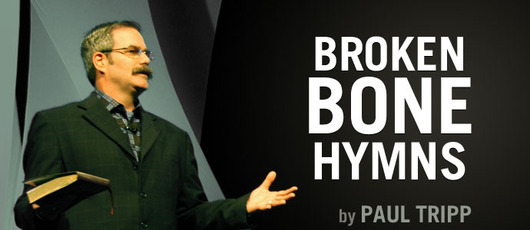
Broken Bone Hymns

A good friend of mine forwarded me the following article by Paul Tripp about the pain that we often feel in the process of God’s plan of redemption.  I hope it encourages you as much as it did me.

Image001

It’s a bit of a strange word picture, the kind that causes you to wonder and to feel just a bit uncomfortable. But it says volumes about what you need and about what it is that God is doing.

If you’re confused about what God’s agenda is in your life, or if it doesn’t always seem like his promises are being fulfilled, then this strange little prayer from Psalm 51 is helpful and clarifying. In his psalm of repentance after his sin against God, Bathsheba, and Uriah, David writes this provocative little prayer, “Let the bones that you have broken rejoice.” What in the world is he talking about and how in the world can it give perspective and hope to you and me?

Let me begin to answer with a personal confession. It’s a bit embarrassing to admit, but I have a low tolerance for difficulty. I confess that I am a project-oriented person. I tend to have a specific agenda for each day. I awake knowing exactly what I want to accomplish and what a successful day will look like. I don’t want to have to deal with interruptions or obstacles. I want the people, circumstances and locations to willingly submit to my sovereignty and participate in my plan. All of this means that it’s counterintuitive for me to view difficulty as something beneficial. I have little time or tolerance for “broken bones.”

But I have a problem. My Redeemer is the redeemer of broken bones. Now, maybe you’re thinking, “Paul, what in the world are you talking about?” Well, here it is. “Broken bones” is a physical word picture for the pain of redemption.

In case you failed to notice, God’s work of delivering you and me from our addiction to self and sin and transforming us into his image isn’t always a comfortable process. There are times, in order to make our crooked and fickle hearts straight and loyal, God has to break some bones. I will again confess, I don’t like broken bones!

Now, you have to ask, “Why would a God of love ever bring pain into the lives of the people he says he loves?” The difficult things that you experience as God’s child that may seem like the result of God’s unfaithfulness and inattention or anger are actually acts of redemptive love. You see, in bringing these things into our lives God is actually fulfilling his covenantal commitment to satisfy the deepest needs of his people. And what is it that we need the most? The answer is simple and clear throughout all of Scripture: more than anything else we need him.

Yet this is exactly where the rub comes in. Although our greatest personal need is to live in a life-shaping relationship with the Lord, as sinners we have hearts that have a propensity to wander. We very quickly forget God and begin to put ourselves or some aspect of the creation in his place. We soon forget that he’s to be the center of everything we think, desire, say and do. We easily lose sight of the fact that our hearts were designed for him and that the deep sense of well-being which all of us seek can only be found in him.

We very rapidly forget or ignore the powerfully addicting dangers of sin and think we can step over God’s boundaries without personal and moral cost. We think we are stronger than we really are and wiser than we actually prove to be. We assess that we have character, discipline and strength that we don’t really have. So God, in the beauty of his redeeming love, will “break our bones.” He will bring us through difficulty, suffering, want, sadness, loss and grief in order to ensure that we are living in pursuit of the one thing that each of us desperately needs—him.

It’s time for each of us to embrace, teach, and encourage others with the broken-bone theology of uncomfortable grace. Because as long as each of us still has sin living in us, producing a propensity to forget and wander, God’s grace will come to us in uncomfortable forms. Perhaps you’ve been wondering where the grace of God is in your life at the very moment when you have been getting it. But it has not been the grace of comfortable relief or release; no, you have been receiving the uncomfortable grace of rescue, restoration, transformation and refinement.

So, if you are God’s child, if you’ve ever prayed that God would be near you and would do what he has promised in and for you, then resist the temptation to doubt his goodness in the middle of your moment of stress. It’s time for you and me to stop thinking that we are going through difficulty because Satan is winning or God is punishing us. If you are God’s child and you humbly recognize and admit that the battle with sin still rages in your heart, then tell yourself that those difficulties are the sure sign of his rescuing and redemptive love.

God hasn’t forgotten you. He hasn’t turned his back on you. He isn’t punishing you in anger. He surely isn’t withholding the grace that he has promised from you. No, you’re receiving grace, but it’s grace that is willing to break bones in order to capture and transform your heart. This grace is unrelenting. This grace has no intention of giving up. This grace will not be satisfied with the status quo. This grace does not get discouraged. It will never compromise. It will never become bitter or cynical. This is loving, patient, perseverant, powerful grace.

In those moments when you are tempted to wonder if God has forgotten you, may you preach to yourself of this relentless, transforming grace. May you remind yourself that you are being loved with real love and showered with real grace. And as you limp to his throne once more to thank him for his unyielding grace, may the bones that he has lovingly broken sing a hymn of praise to this One who alone blesses you with his amazing grace.

what does it take to form a community?

We’ve been talking a lot about gospel-centered community here lately – particularly what does it look like.  Generally what I find is that it looks nothing like I think it should.  It is far messier and life-disrupting than I would have ever thought.  This was brought home to me by a section in the book, Total Church

G. K. Chesterton said, “The man who lives in a small community lives in a much larger world…The reason is obvious.  In a large community we can choose our companions.  In a small community our companions are chosen for us.”  Community has been insightfully defined as the place where the person you least want to live with always lives!  Responding to this, Philip Yancey says, “We often surround ourselves with the people we most want to live with, thus forming a club or clique, not a community.  Anyone can form a club; it takes grace, shared vision, and hard work to form a community.”  We might also add that it takes a miracle that only God himself can perform.  But it is in such a community that disciples are made.  To be a community of light from which the light of Christ will emanate we need to be intentional in our relationships – to love the unlovely, forgive the unforgivable, embrace the repulsive, include the awkward, accept the weird.  It is in contexts such as these that sinners are transformed into disciples who obey everything King Jesus has commanded.

We can do this because Christ and his kingdom community has loved us who were unlovely, unforgivable, repulsive, awkward and weird.  

what does it take to form a community?

We’ve been talking a lot about gospel-centered community here lately – particularly what does it look like.  Generally what I find is that it looks nothing like I think it should.  It is far messier and life-disrupting than I would have ever thought.  This was brought home to me by a section in the book, Total Church

G. K. Chesterton said, “The man who lives in a small community lives in a much larger world…The reason is obvious.  In a large community we can choose our companions.  In a small community our companions are chosen for us.”  Community has been insightfully defined as the place where the person you least want to live with always lives!  Responding to this, Philip Yancey says, “We often surround ourselves with the people we most want to live with, thus forming a club or clique, not a community.  Anyone can form a club; it takes grace, shared vision, and hard work to form a community.”  We might also add that it takes a miracle that only God himself can perform.  But it is in such a community that disciples are made.  To be a community of light from which the light of Christ will emanate we need to be intentional in our relationships – to love the unlovely, forgive the unforgivable, embrace the repulsive, include the awkward, accept the weird.  It is in contexts such as these that sinners are transformed into disciples who obey everything King Jesus has commanded.

We can do this because Christ and his kingdom community has loved us who were unlovely, unforgivable, repulsive, awkward and weird.